|
PLACES FOR DAY BREAKS
Saklikent Gorge
Beyond Tlos, Saklikent is a spectacular gorge cut into the Akdaglar mountains. 18 km long,
the sides are so deep and steep that no sun penetrates, so the water always remains icy cold.
Access to the start of the gorge is along a wooden boardwalksuspended above the water, then after
crossing the river, it is fairly straightforward to walk through the gorge for 6km. In the summer,
there are tours arranged from Kas and Kalkan.Opening hours: Daily 08.00 - 17.00.
Patara (Ovagelemis)
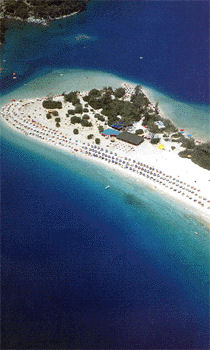
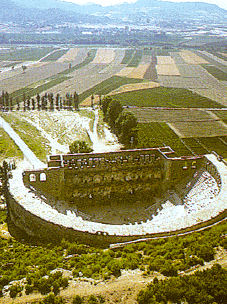
Once a principle harbour of ancient Lycia, Patara was the birthplace of Apollo, according to Greek legend. This village covering a wide area on the eastern part of the harbour is 41km from Kas and has one of the best beaches in the area, a white goldenstretch around 20km long. Patara gained importance during the Byzantine period, because it was the birthplace of St Nicholas, the 4th century bishop better known as his other identity, Santa Claus. St Paul, one of Christ's disciples, boarded a shipfrom Patara to Rome. The ruins lie 1km from the beach, and include several Lycian tombs, a basilica, Corinthian temple and a theatre. Access is possible by dolmus from most adjacent towns, although not at night. The Lycian Roman monuments can be seen when entering Patara. From the Vespasianus Hamam, constructed between 69 - 79 AD, the adjacent footpath reaches the main, marble-covered street of Patara. At the end of the street are the wide walls of theByzantine Castle, and east of that is the Corynth Temple. Patara Theatre, built in the 2nd century BC, is at the foot of the hill and had a capacity for around 10,000 people. It was filled with wind-swept sand but after cleaning revealed its structure, and archaeological excavations are still continuing. The beach is one of the longest in Turkey, with a width of up to 1500m. Declared a Special Environmental Preservation Region by the Ministry of the Environment, it is a major breeding area for the caretta-caretta sea turtles, and during thereproductive season there are strictly applied restrictions to preserve their habitat.
Xanthos
Along the east coast of the Esen River, 45km from Kas, Xanthos was the capital and grandest city of the Lycian Union, but has had a chequered history. Surface findings from the city acropolis reveals that the settlement dates back to the 8th centuryBC. Initial research was performed by Englishman Charles Fellows in 1838, which probably explains why the Nereidler and Harpyler monuments, the Payave Tomb and Aslani Grave were taken to the British Museum in 1842. The city walls were repaired during the Roman and Byzantium periods, and strengthened with additions to the width. At the south end, a gate dates back to 2nd century BC, and behind this there is Victory Arch belonging to Emperor Vesoasianus. To thesouthwest, the original settlement of the city is the Lychian Acropolis, now badly ruined, with a Byzantine Church.
Bezirgan (Pirha)
This important plateau village is 20 minutes walks from Pirha ruins, an ancient city 850m above the sea. There are many rock graves, all facing the sea, and the tombs are more irregularly positioned. The statues and reliefs that were uncovered hereare now in the Antalya Museum.
Gombe
An ideal place to escape the summer heat is Gombe, 60km north of Kas, in the cool plateau of the Akdag mountain range. The forest-covered route with pine and cedar trees almost conceal the village, famous for its cools springs and apple orc.ards.Akdag is the highest mountain in this range, reaching 3024m, and the villages of Yesilgol and Ucarsu are good for trekking. The herbs which grow in this area are used in local cooking and there are several restaurants in the main square. There is afamous festival of the local Tahtacis in June, and a farmers' fair in late August.
Antiphellos
This is the original name of the ancient Lycian town, although there is little left of Antiphellos except a well-preserved ancient theatre and Lycian rock tombs. One of the most important of these ruins is the Monument Tomb, a Lychian inscribed tombmounted on a high base, dating back to 4th century BC, also called King's Tomb. Another important item is the ancient theatre, dating back to 1st century BC which once had a capacity of 4000 people.
This well-preserved theatre is the only one in Anatolia to be overlooking the sea. It lies 500m west of the main square.Northeast of the theatre is a house-style tomb dating back to the 4th century BC. It has been constructed by cutting into the natural rock, lies 3.5m high with engravings of 24 girls dancing. Near Hastsane Caddesi, on the western coast of the town,there is a temple whose foundations date back to the Roman era.
Felen Plateau (Phellos)
The region of hills over the Felen Plateau, 12km from Kas, was a highly important city during the 4th century BC. Antiphellos was the harbour of Phellos, and some of the surrounding city walls still remain. Also surrounding the city is a tomb,decorated with reliefs, 4th century tombs and rock-cut graves.
Belenli (Isinda)
Isinda, on the hills near Belendi village 13km from Kas, was a small Lycian city and surrounded by ramparts. In the middle of the city's acropolis, two tombs with Lycian inscriptions are the main attractions. There are also many Lycian rock tombs fromthe Roman period.
Sutlegen (Nisa)
80km from Kas, this is another important plateau village, with ruins 15 minutes walk away. Neiseus, the city's Lycian name, is written on the theatre wall. In Nisa, there are ancient ruins from the Lycian and Roman periods, and on the front of some ofthe tombs there are images of spears, shields, women and men. Coins produced during this time are exhibited in Antalya Museum.
Kekova (Sunken city)-Teimiussa
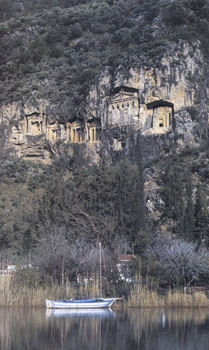
A fascinating Lycian necropolis, with chest-type tombs spread out along the coastline, lies at Teimiussa, near the present-day Uçagiz on the mainland across from Kekova.
This can also be reached by track from the main road between Kas and Demre.
The ancient city of Simena was once of two parts - an island and a coastal part of the mainland.
On the mainland the charming village of Kale ("castle") stands today, its buildings mingling
with ancient and medieval structures. At the top of the village sits a well-preserved
crusaders? castle built partially upon ancient Lycian foundations. Inside the castle is the
smallest amphitheatre of Lycia. At the eastern end of the village is a cluster of some very
nice sarcophagi overlooking the sea and surrounded by ancient olive trees. Near the harbour
of Kale is another sarcophagus, popping up from the water. Across the bay, along the island
are the half-submerged ruins of the residential part of Simena, caused by the downward shift
of land by the terrible earthquakes of the 2nd century AD. Half of the houses are submerged
and staircases descend into the water. Foundations of buildings and the ancient harbor are
also seen below the sea.
Home
|
 |
 |
 |
 |
 |
|
|

))
))
))
))
))
))
))

